
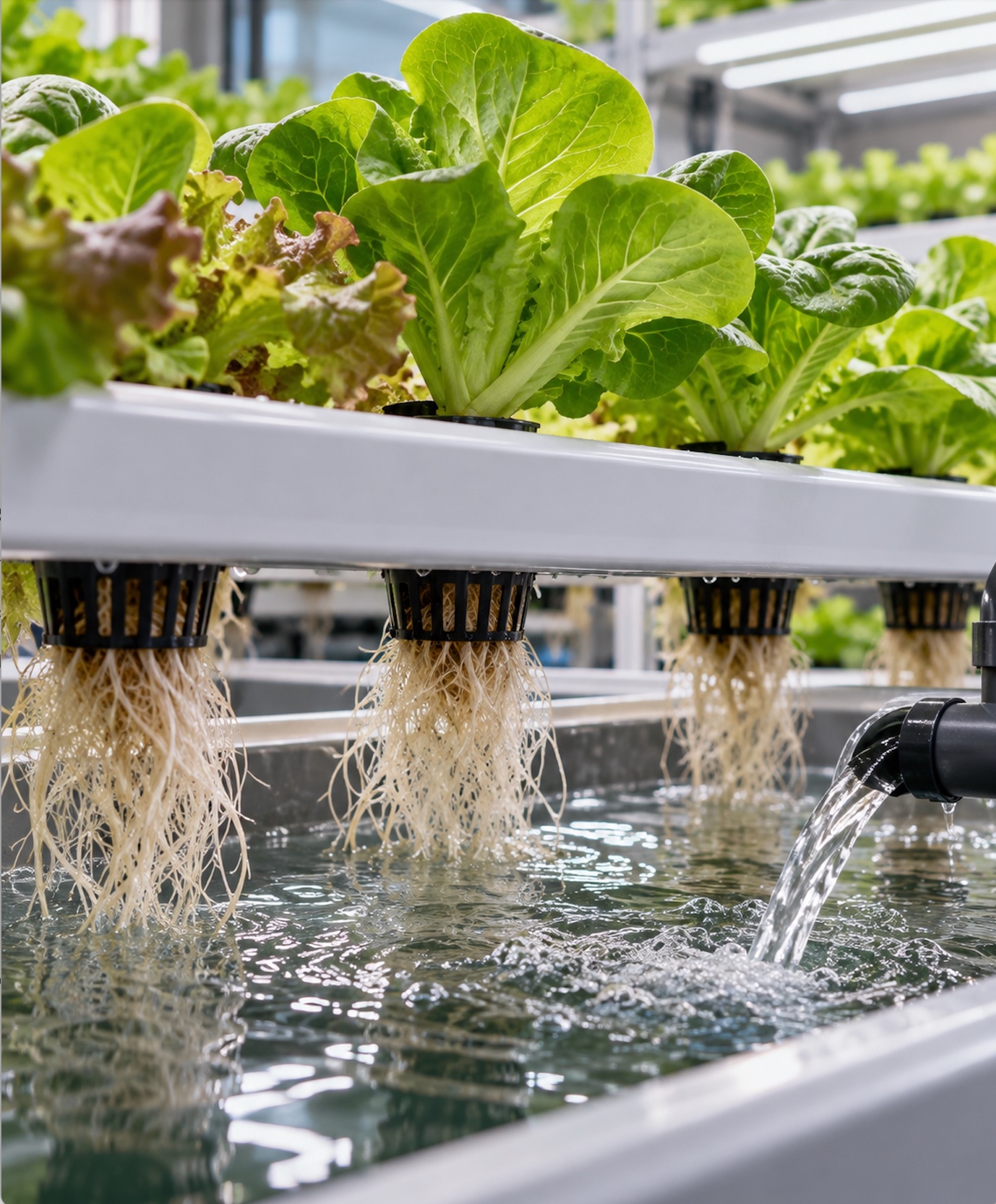
Growing plants without soil may sound unusual, but the principle behind hydroponics is relatively simple: instead of relying on the soil to provide water and nutrients, plants receive what they need through a controlled nutrient solution.
This makes it possible to manage growing conditions more precisely and to cultivate in environments where traditional soil-based farming may be difficult, impractical or simply not the best option.
From small-scale growing to indoor farms, greenhouses and professional cultivation, hydroponics can take many different forms. What they all have in common is the central role played by water and by the conditions in which the root system develops.
What is hydroponics?
Hydroponics is a method of growing plants without soil.
Plant roots receive water and dissolved nutrients through a nutrient solution, while oxygen is supplied to the root zone in different ways. Depending on the type of installation, the roots may be suspended directly in water, supported by an inert growing medium or periodically supplied with the nutrient solution.
The absence of soil does not mean that plants need fewer resources. It means that those resources are supplied and managed differently. Instead of relying on the natural characteristics of the soil, growers can monitor parameters such as nutrient concentration, pH, oxygenation and water temperature more directly.
This greater degree of control is one of the main characteristics of hydroponic cultivation.
How does a hydroponic system work?
Although hydroponic systems can differ considerably in size and design, the basic principle remains the same: the nutrient solution delivers water and dissolved nutrients to the root zone and is managed according to the needs of the crop.
In many systems, the nutrient solution is collected and recirculated rather than being discarded after a single use. Pumps, reservoirs and irrigation or circulation systems can be used to deliver and move the solution, while the root zone must also receive adequate oxygen.
There are several types of hydroponic systems. Among the most common are:
- DWC and RDWC systems, where roots grow directly in oxygenated nutrient solution;
- NFT systems, in which a thin film of nutrient solution flows continuously along the roots;
- drip systems, where nutrient solution is delivered directly to each plant;
- ebb and flow systems, which periodically flood and drain the growing area.
There is no universally “best” system. The most suitable configuration depends on factors such as the crop, available space, scale of production, level of automation and the grower’s objectives.
What are the main benefits of hydroponics?
One of the main advantages of hydroponics is the ability to control the growing environment more precisely.
Because water and nutrients are supplied directly to the root zone, growers can adjust conditions according to the needs of the plants and respond more quickly when parameters change.
Hydroponics can also make more efficient use of water, particularly in recirculating systems where the nutrient solution is collected and reused rather than continuously discharged.
Another advantage is independence from soil conditions. Hydroponic systems can be installed in places where suitable agricultural soil is unavailable, from urban environments and indoor spaces to greenhouses and highly controlled production facilities.
Space can also be used in different ways. Hydroponics is compatible with compact installations as well as vertical farming, where growing areas are arranged on multiple levels.
Where is hydroponics used?
One of the strengths of hydroponic cultivation is its versatility.
At a small scale, it can be used for home growing, including compact systems for balconies, terraces or indoor spaces.
At a larger scale, hydroponics is widely used in greenhouses and indoor cultivation, where environmental parameters can be controlled more closely and production is less dependent on external soil conditions.
It also plays an important role in vertical farming, where the objective is to maximize cultivation within a limited footprint, as well as in experimental, research and professional growing environments.
Whatever the scale or setting, successful hydroponic growing depends on maintaining suitable conditions around the root zone.
Which parameters need to be controlled in hydroponics?
In soil, several physical and biological processes help regulate the environment around plant roots. In hydroponics, many of those conditions need to be managed directly.
Among the main parameters growers monitor are:
- nutrient concentration;
- pH;
- dissolved oxygen;
- water circulation;
- environmental temperature and humidity;
- temperature of the nutrient solution.
These variables are interconnected. A change in one can influence others, which is why stability is often just as important as reaching a specific target value.
The ideal conditions also depend on the crop and the type of system, so there is no single set of parameters that applies universally to every hydroponic installation.
Why does water temperature matter in hydroponics?
Because roots are in direct contact with water or nutrient solution, water temperature becomes an important part of the root-zone environment because it influences several processes, including dissolved oxygen availability and the conditions surrounding water and nutrient uptake by the roots.
As water becomes warmer, its ability to hold dissolved oxygen decreases, making temperature management particularly relevant in systems where roots remain continuously immersed.
At the same time, excessively low temperatures can also affect plant development. The objective is therefore not simply to “keep the water cold”, but to maintain a stable temperature appropriate for the crop and the system.
This can become more challenging in indoor environments, warm climates, greenhouses or installations where pumps, lighting and surrounding equipment add heat to the water.
For this reason, temperature control should be considered as part of the overall design and management of a hydroponic system, rather than as a parameter to address only when problems appear.
This is where TECO PONIC comes in.
Drawing on TECO’s experience in refrigeration, we develop solutions specifically designed to manage water and nutrient-solution temperature in hydroponic growing, with options for systems of different sizes and configurations.
From conventional chillers to Drop-in solutions that can be immersed directly in tanks and reservoirs, our goal is simple: help growers keep water temperature where it needs to be, whatever the scale of the system.


